KITCHEN HANDLES GUIDE
Styles, materials, brands, and how to choose.
Handles are the detail you interact with more times a day than almost anything else in the kitchen. They are also one of the easiest things to get wrong, and one of the fastest ways to lift the quality of a kitchen if you get them right.
HANDLE VS HANDLELESS
Handleless kitchens fall into two main types, and it is worth knowing the difference before committing to either.
J-pull profile kitchens use a recessed groove routed into the top or side of the door. This gives a completely clean front elevation with no hardware at all. You can see a good example of this in The Hinckley Kitchen. Slightly less practical with wet or floury hands, and the groove can collect crumbs in a busy kitchen.
Gola rail kitchens use a continuous aluminium/MFC channel fixed along the top of the base units. This also gives a seamless look from the front but provides a more comfortable grip than a J-pull, particularly on lower base units. Our Gola range is a good example of this approach, as you can see in The Oadby Kitchen.
Both styles work best in a kitchen that is used carefully rather than a very busy family kitchen with young children. Handled kitchens remain more practical across a wider range of households and suit more styles, from shaker through to in-frame.
FINISHES AND MATERIALS
- Brushed brass / antique brass. The most requested finish at the moment. Pairs exceptionally well with warm colours: navy, forest green, sage, cream. Both Hendel & Hendel and ECF's own collection handle this particularly well.
- Matte black. Contemporary and strong. Works well in darker kitchens and as an accent finish alongside handleless cabinetry.
- Chrome / brushed nickel. Neither dates quickly nor excites particularly. A safe choice for any style.
- Ceramic knobs. Making a quiet comeback in country-style and traditional kitchens. Particularly effective in cream or white painted shaker kitchens.
- Stainless steel. Clean, practical, suits contemporary and Scandi-influenced kitchens well.
FINISH MATCHING
One of the details that separates a well-resolved kitchen from a busy-looking one is keeping the metal finishes consistent. Your handles, tap, sockets, and light fittings should all speak to each other. They do not need to be identical, but mixing warm brass handles with cool chrome sockets and a gunmetal tap in the same kitchen tends to look unresolved, even when each individual piece is attractive on its own. Decide on a finish direction at the start of the design process and carry it through every element.
BRANDS AND SUPPLIERS
ECF
Where we start on most projects. Good quality, well-priced, and well-matched to the door ranges we supply. Covers the majority of briefs without needing to go elsewhere.
Hendel & Hendel
Higher specification and a broader, more distinctive range. Worth the step up for clients who want something more individual. Particularly strong on brass and traditional finishes.
Hafele
Wide range, reliable quality, available from their Rugby depot. Particularly strong on bar handles and contemporary options.
LDL Online
Strong on premium and architectural handle styles. Good for clients who want something you will not see in many other kitchens locally. We specify through LDL for more individual briefs.
The upgrade from a standard £5 handle to a £25 Hendel & Hendel equivalent across a 20-door kitchen adds around £500 to the total. The difference in look and feel is immediately noticeable. It is one of the best-value upgrades available in a kitchen specification.
FREQUENTLY ASKED QUESTIONS
How many handles will a typical kitchen need?
Most kitchens have between 20 and 35 handles depending on the number of doors and drawers. We provide a full handle schedule as part of the design specification so you know exactly what is included.
Can I mix handle finishes?
Yes, if done deliberately. Matte black handles with brass taps and sockets is a popular combination. Mixing chrome and brass across major fixtures generally looks unresolved and is worth avoiding unless the finishes are very close in tone.
What type of handle should I choose?
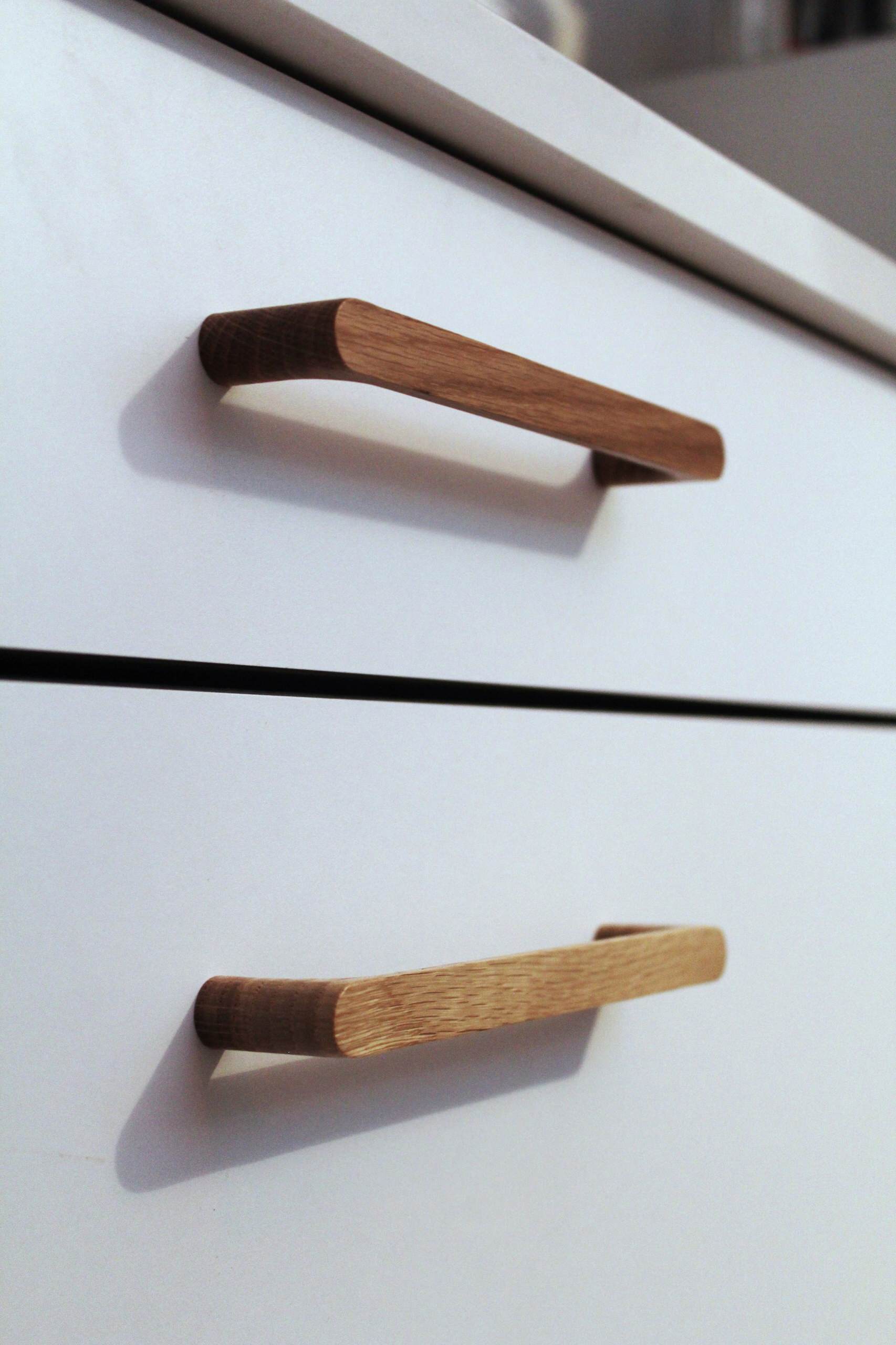
We recommend using a strong bar handle on a heavy fridge/freezer door or a cup handle on a dishwasher/pull out door. knobs are generally used for hinged doors that don't need much force to open them.
Can I change the handles after the kitchen is fitted?
It depends on the type of handle. Knobs are easy to swap out at any point as they are fixed with a single bolt and hole positions are not critical. Bar handles are trickier because the distance between the two fixing holes (the hole centres) must match exactly.
If you change to a different bar handle with different hole centres, you will need to re-drill, which means filling and touching up the existing holes. If you are genuinely undecided, go with knobs or the simplest option and upgrade later. Getting it right first time is always better, but it is not the disaster that a worktop change would be.